go to home page go to byland abbey pages go to fountains abbey pages go to kirkstall abbey pages go to rievaulx abbey pages go to roche abbey pages
The Cistercians in Yorkshire title graphic
 

Text only version

Roche Abbey: location

Roche Abbey: history
Sources
Foundation
Consolidation
Rise and Fall
Dissolution
Spoliation

Roche Abbey: buildings
Precinct
Church
Cloister
Sacristy
Library
Chapter House
Parlour
Day Room
Dormitory
Reredorters
Warming House
Refectory
Kitchen
Lay Brothers' Range
Abbots'Lodging
Infirmary
Guesthouse
Gatehouse

Roche Abbey: lands

Roche Abbey: people

Multimedia

Abbeys

People

Glossary

Bibliography

Contact Us


View movies

Sign language

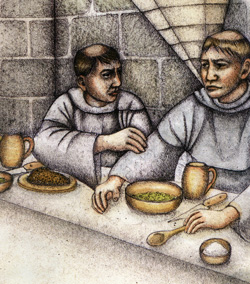
Artist's impression of a monk signing at dinner
Artist's impression of monks signing at dinner

To preserve silence in the cloister monks communicated using signs, which were made with the hands and fingers. The codification of signs began at the reformed Benedictine house of Cluny in the tenth century, and was soon taken on by other orders. A surviving Clairvaux manuscript contains a list of 227 signs which were made using the fingers and hands. Signing was intended to convey essential information; it was not meant for conversation or as an excuse for frivolity. At Lent the Cistercians did not simply follow an abstemious diet but were also urged to minimise speech and signing, thus fasting with the tongue and hands as much as the stomach.